
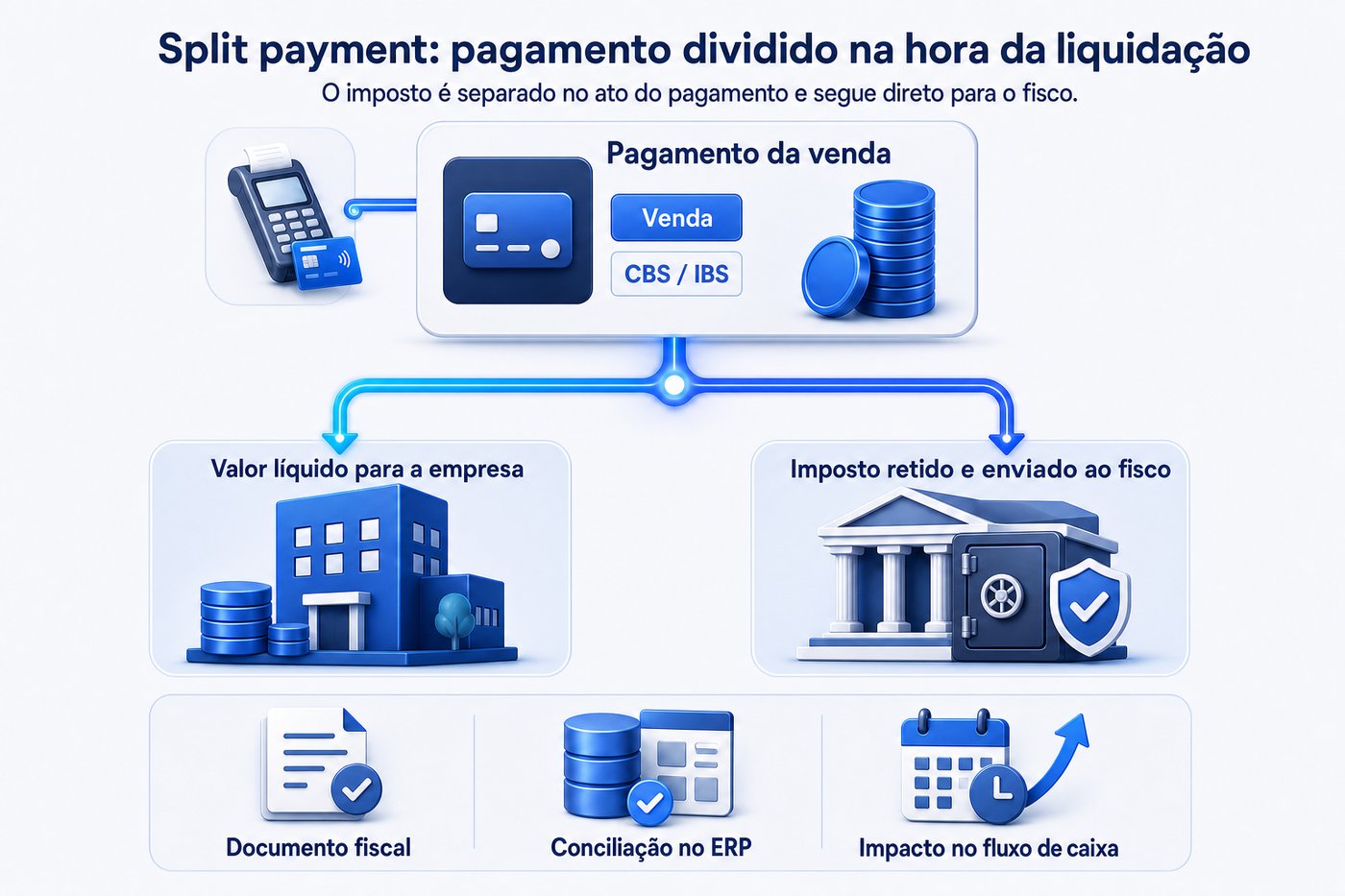
What split payment is
Split payment is exactly that — a divided payment. When a sale is settled financially — by card, PIX, boleto, or another method — the portion corresponding to the new taxes (CBS and IBS) is automatically separated and paid to the tax authority at that same instant. The seller receives the transaction amount already net of the tax; the tax portion never passes through their account.
The mechanism was established by the reform — through Constitutional Amendment 132, in December 2023 — and detailed by Complementary Law 214/2025. It's the backbone of collection in the new dual-VAT model: instead of trusting that the taxpayer will assess and pay the tax later, the system collects it at the source, at the moment of settlement.
Why it exists
The logic is to reduce evasion and tax delinquency. In the traditional model, between receiving from a customer and passing the tax on to the government there's a window — and in that window a great deal of tax simply went unpaid. Split payment closes that window: if the sale was paid, the tax was collected. There's no more "forgetting" or postponing.
For the tax authority, it's predictability and fraud prevention. For the honest company, it's a change in cash regime that must be planned — because the side effect falls on working capital.
The real impact is on cash flow
Here's the point most managers underestimate. In the old model, the tax amount stayed in the company's account for some time between receiving the sale and the collection date. In practice, that money worked as temporary working capital — it circulated in the operation before becoming tax.
With split payment, that slack disappears. The tax leaves immediately. For companies that relied on that interval to fund the month's operation, it's a real reduction in cash flow that has to enter financial planning before the rule tightens — not after, when cash is already short.
There's also the matter of credits. A "smart" split payment considers the credits the company is entitled to and withholds only the net amount due. A simpler withholding, on the other hand, may hold back too much, requiring assessment and a refund later — which, again, is money parked outside your cash for a while. Understanding which model applies to each transaction is part of the planning.
What changes in financial reconciliation and in the ERP
Split payment rewrites reconciliation. Until now, accounts receivable matched the sale amount against the amount received. Now there's a third piece: the sale amount, the amount received (net), and the tax withheld at settlement. The ERP has to record and reconcile all three — per transaction, per payment method, per acquirer.
- Receivables net of tax: each settlement arrives discounted of the tax, and the system needs to tie that discount back to the source tax document.
- Integration with payment methods: acquirers, banks, and payment arrangements become part of the collection chain — and of the information that needs to flow back to the ERP.
- Assessment and credits: what was withheld at the source must talk to the CBS/IBS assessment, so you neither pay twice nor leave credit on the table.
- Closing and audit: the trail between sale, receipt, and tax collected must be traceable, or the closing turns into a hunt for discrepancies.
How to prepare
- Redo your cash-flow projection considering tax leaving at the moment of settlement, no longer the following month. It's the most important step — and the one that doesn't depend on a system, it depends on a decision.
- Get your ERP on the right version and configuration to calculate CBS/IBS and reconcile net receivables — which goes hand in hand with the release upgrade and the new tax configurator.
- Map your operation's payment methods and how each one will report the withholding, so reconciliation doesn't break.
- Align the treatment of credits and the assessment with accounting, so the source withholding and the periodic assessment reconcile.
The practical takeaway
Split payment isn't only a tax topic — it's a treasury and systems topic. Accounting defines the tax side; the finance leadership must anticipate the cash-flow side; and the execution side — calculation, reconciliation, integration — lives in the ERP. Companies that handle all three together will get through the transition without cash surprises. Those that discover the change at the first closing will feel it in the wallet.
The rules, deadlines, and the way split payment is operationalized are still being detailed by regulation; always confirm the tax aspects with your accounting advisors. This content covers the impact on cash flow, reconciliation, and the ERP.